How to Play Sudoku
A complete beginner's guide - from the rules to your first solved puzzle. No math required.
What is Sudoku?
Sudoku is a logic puzzle played on a 9×9 grid. Your goal is simple: fill every empty cell with a number from 1 to 9, following three rules. There is always exactly one correct solution, and you can reach it through pure logic - no guessing needed.
Despite using numbers, Sudoku is not about arithmetic. Think of the digits as symbols; you could replace them with letters or shapes and the puzzle would work identically.
The Grid
The 9×9 grid is divided into three types of units, each of which must contain every digit from 1 to 9 exactly once:
- 9 Rows - the nine horizontal lines.
- 9 Columns - the nine vertical lines.
- 9 Boxes - the nine 3×3 squares (also called regions or blocks).
Every cell belongs to exactly one row, one column, and one box - three units simultaneously. This overlap is what makes Sudoku interesting.
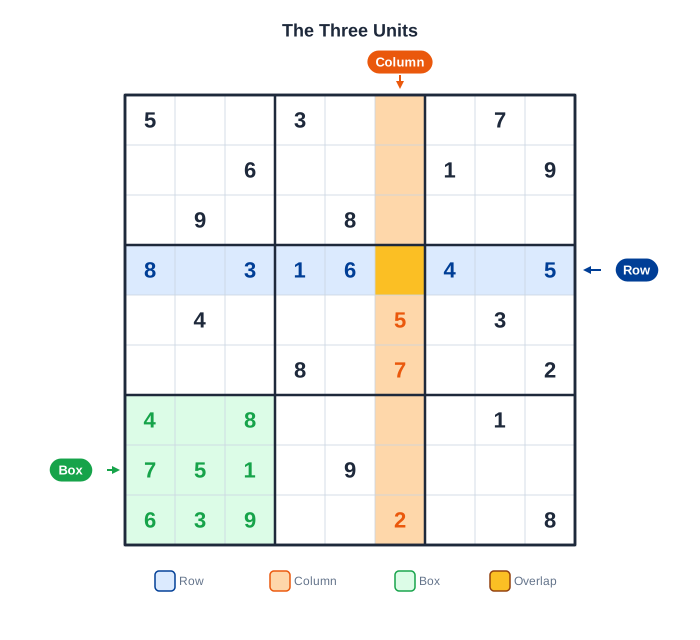
A row, a column, and a 3×3 box - the three units every digit must appear in exactly once.
The Three Rules
Every row, every column, and every 3×3 box must contain each of the digits 1–9 exactly once. No repeats. No gaps.
That's it. Three rules, one constraint: no digit can appear twice in the same row, column, or box.
How to Solve: Step by Step
Scan the givens. Start by studying the numbers already printed in the grid (called givens or clues). Notice which digits appear most often - cells in rows, columns, and boxes that share many givens are easiest to solve first.
Find a forced cell (Naked Single). Look for any empty cell where only one digit is possible. Cross-check the cell's row, column, and box - if eight different digits already appear across those three units, the ninth is the only option. Write it in.
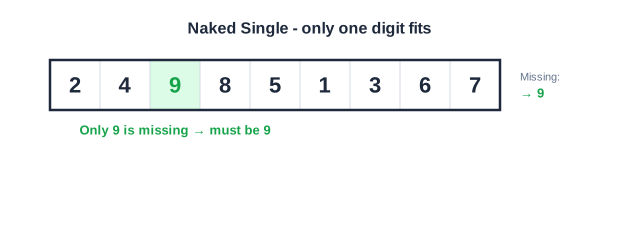
Eight digits fill this row - the empty cell can only be 9.
Find a forced digit (Hidden Single). Pick any digit - say, 7. In each box, check whether 7 can only go in one cell (all other cells in the box are either filled or blocked by a 7 in the same row or column). If so, that cell must be 7.
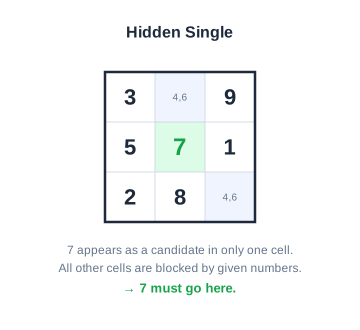
Even though this cell has multiple candidates, 7 is the only digit that fits here in this box.
Use pencil marks. For harder cells, lightly write all possible candidates in the corner of each empty cell. As you fill in digits elsewhere, erase candidates that become impossible. When a cell is left with only one candidate, fill it in.
Repeat and ripple. Every cell you solve removes candidates from related cells, which can reveal new forced cells. Keep scanning rows, columns, and boxes. For most easy and medium puzzles, steps 2–4 are all you need.
A Worked Example
Consider this row: _ 4 _ 8 _ 1 _ 6 _
The missing digits from 1–9 are: 2, 3, 5, 7, 9. Now imagine the column containing the first blank already has a 3, 5, and 9 - and the box it sits in already has a 7. That leaves only 2 as the valid digit for that cell. You've solved it by elimination alone.
Beginner Tips
- Start where it's densest. Focus on rows, columns, or boxes that already have 6 or more digits filled in - fewer unknowns means fewer options to consider.
- Work one digit at a time. Scan the entire grid for all placements of a single digit (e.g., all the 5s) before moving to the next. This catches hidden singles quickly.
- Never guess. If you feel stuck, you haven't exhausted the logic yet. Slow down and re-examine every row, column, and box.
- Use pencil marks early. On medium or hard puzzles, jotting candidates from the start saves time and prevents errors.
- Check your work. After filling in a digit, immediately scan the affected row, column, and box for new forced cells - fresh deductions appear fastest right after a placement.
- One unit at a time. If the full grid feels overwhelming, zoom in: solve one box completely, then move to the next.
Difficulty Levels
Sudoku difficulty is determined by which techniques are required to solve the puzzle - not how many clues are given.
- Very Easy / Easy: Naked singles alone solve the puzzle. Great for first-timers.
- Medium: Hidden singles and some pencil-mark scanning required.
- Hard: Intermediate techniques like naked pairs or pointing pairs are needed.
- Expert: Advanced techniques (X-Wing, chains) are required. See our advanced guide.
Ready to practice?
Download a free printable Sudoku sheet and try what you've learned.
Get Free Puzzles Advanced Techniques →