Sudoku Tips & Advanced Techniques
Go beyond the basics. This guide covers intermediate and advanced strategies for solving harder puzzles - from naked pairs to X-Wing and Swordfish.
The Solving Ladder
Every technique has its place in the solving order. Always exhaust simpler techniques before reaching for harder ones - a naked single you missed is faster than an X-Wing you found.
General Tips for Every Puzzle
- Always use pencil marks. For anything harder than Easy, mark all candidates in each empty cell before trying to solve. Trying to hold candidates in your head leads to mistakes.
- Update candidates immediately. Every time you place a digit, erase that digit as a candidate from every other cell in the same row, column, and box before moving on.
- Scan all three unit types. Don't fixate on boxes alone. Some placements only become obvious when you scan a row or column for where a digit can go.
- Start with the most-constrained digit. Find whichever digit (1–9) appears most often in the grid and place all its remaining instances first - fewer open cells means fewer candidate options.
- Look for boxes with 7+ givens. A box with 7 or 8 filled cells has only 1–2 empty cells. These are trivially solvable and often cascade.
- Re-scan after every placement. A single placed digit can unlock multiple new cells. Don't jump to a harder technique until you've exhausted what your last placement revealed.
- Never guess. If you think you need to guess, you haven't found the right technique yet. Every valid puzzle has a logical path to the solution.
Intermediate Techniques
These techniques unlock most Medium and many Hard puzzles. Master them before moving to advanced strategies.
Naked Pair Medium
When two cells in the same unit share exactly the same two candidates - and only those two - those two digits must go in those two cells (in some order). You can eliminate both candidates from every other cell in that unit.
{3, 7}. You don't know which is 3 and which is 7, but you know 3 and 7 are taken by those cells. Remove 3 and 7 from all other cells in that row.
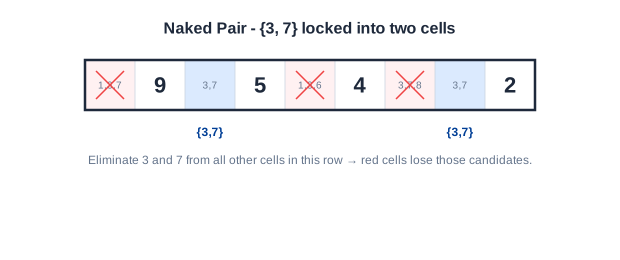
Blue cells hold the naked pair {3,7} - crossed-out cells lose those candidates.
Naked Triple Medium
A generalization of Naked Pair: three cells in a unit collectively contain only three candidates (distributed among them - each cell may have 2 or 3 of the three). Those three digits belong exclusively to those three cells. Eliminate them from all other cells in the unit.
{1,2}, {2,3}, {1,3}. Together they use only digits 1, 2, 3 - remove 1, 2, and 3 from the rest of the unit.
Hidden Pair Medium
When two digits appear as candidates in exactly the same two cells within a unit - and those digits don't appear elsewhere in the unit - those two cells must contain those two digits. Remove all other candidates from those two cells.
{4, 6, 8, 9}, you can reduce it to {4, 8} because 4 and 8 must go there.
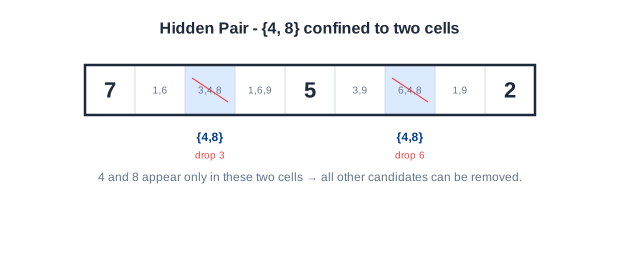
4 and 8 appear only in these two cells - all other candidates are eliminated from them.
Pointing Pair / Pointing Triple Medium
When a candidate digit is confined to a single row or column within a box, it must be placed in one of those cells. Because of that confinement, the digit can be eliminated from all other cells in that row or column outside the box.
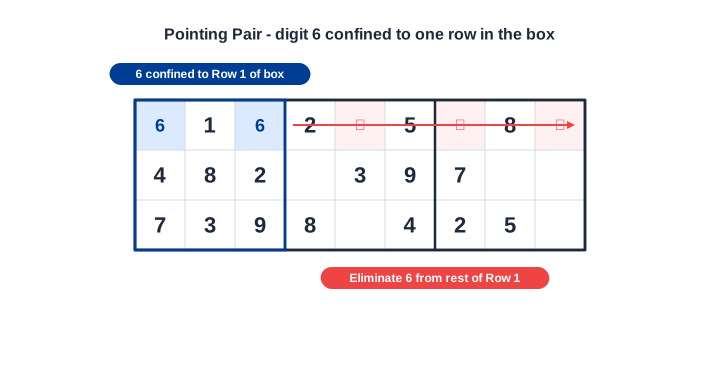
Digit 6 is locked to row 2 inside the left box - all other row-2 candidates for 6 are eliminated.
Box/Line Reduction Medium
The reverse of pointing pairs. When a candidate in a row or column is confined entirely within one box, you can eliminate that candidate from all other cells in that box (even those not on the row/column).
Advanced Techniques
These are the tools for Hard and Expert puzzles. They require systematic scanning of the full grid rather than a single unit.
X-Wing Hard
When a candidate digit appears in exactly two cells in each of two different rows, and those cells fall in the same two columns, a pattern emerges. The digit must be placed in those rows at those columns - so it can be eliminated from all other cells in those two columns.
Why it works: One of four corner cells holds each column's 5. Either way, columns 2 and 7 are "used up" for digit 5 in rows 1 and 6. Any other 5 in those columns would violate the uniqueness rule.
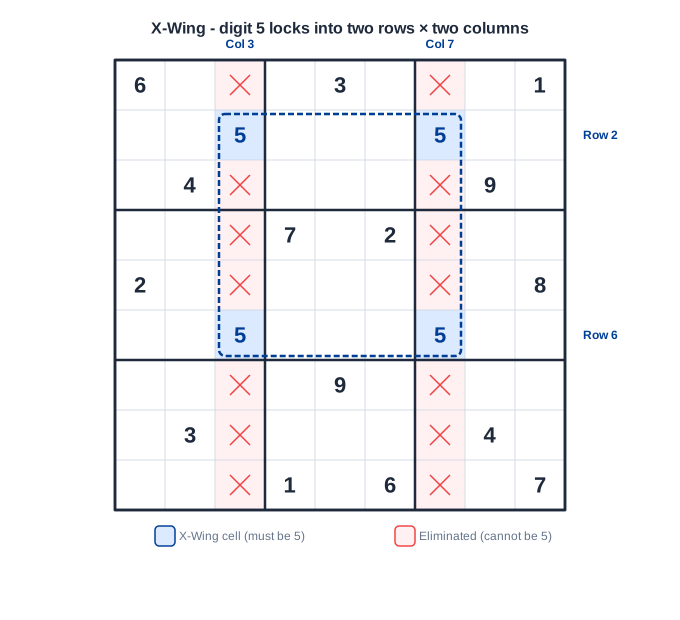
The four blue cells form a rectangle. Digit 5 must land in one of each pair - eliminating 5 from all other cells in those two columns.
Swordfish Hard
A three-row extension of X-Wing. A candidate appears in exactly two or three cells in each of three rows, and those cells collectively span only three columns. Eliminate the candidate from all other cells in those three columns.
Tip: Swordfish is rare. Before looking for it, make sure you haven't missed a simpler technique.
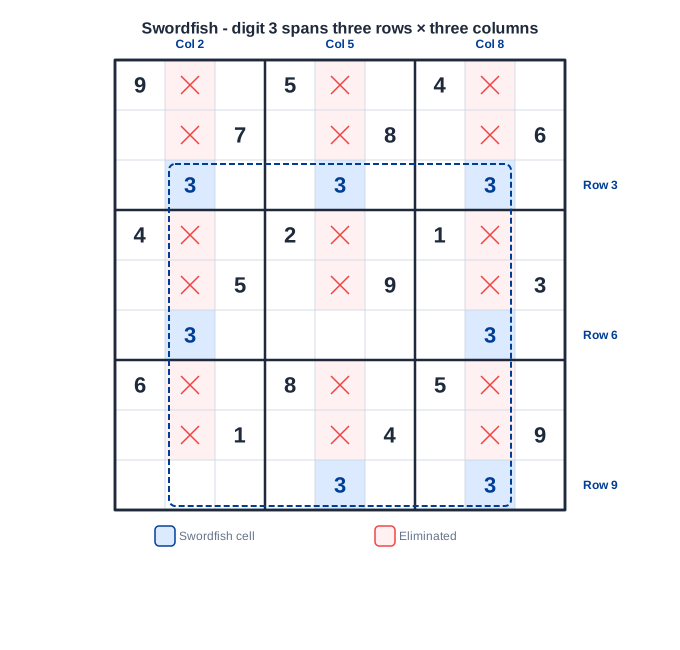
Digit 3 spans exactly three rows × three columns - eliminating 3 from all other cells in those columns.
XY-Wing (Y-Wing) Expert
Three cells form a "wing" pattern. A pivot cell has two candidates {X, Y}. Two wing cells each share one candidate with the pivot: one shows {X, Z}, the other {Y, Z}. Regardless of how the pivot resolves, one of the wing cells must be Z. Any cell that sees both wing cells cannot be Z.
{4, 7}. Wing A at R1C8 has {4, 9}. Wing B at R5C1 has {7, 9}. If R1C1 is 4, then R1C8 is 9. If R1C1 is 7, then R5C1 is 9. Either way, any cell that sees both R1C8 and R5C1 cannot be 9.
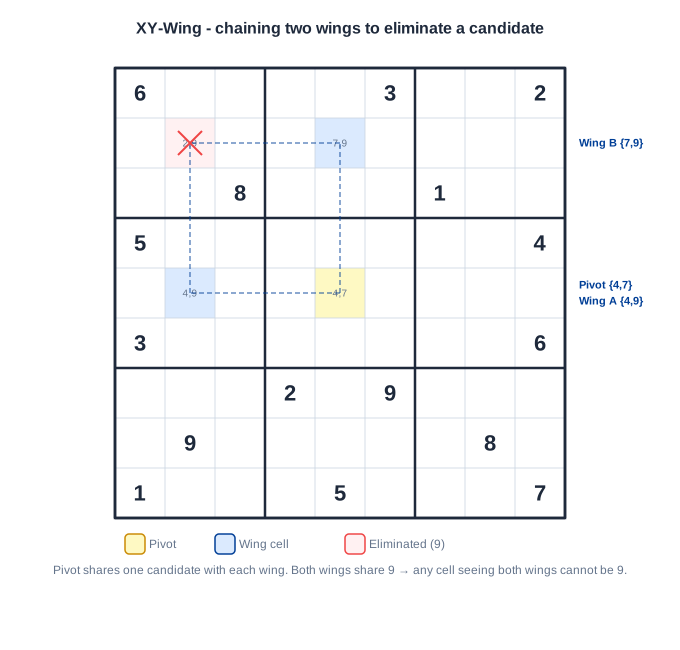
Yellow pivot links to two blue wing cells. The cell seeing both wings cannot be 9.
Skyscraper Hard
A simpler chain-based technique. A candidate appears in exactly two cells in two different rows (or columns), forming a connected structure through a shared column (or row). The two "ends" of the skyscraper see each other's peers - any cell that sees both end cells can have the candidate eliminated.
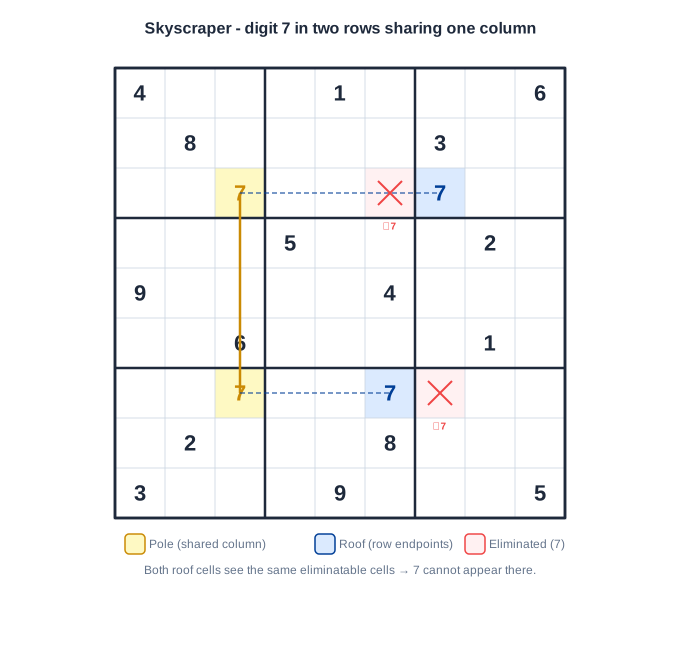
Yellow pole connects two rows. Blue roof cells see the same peers - eliminating 7 from those cells.
The Right Mindset for Hard Puzzles
- Be systematic, not hopeful. Scan every row, every column, every box for each digit before concluding a technique doesn't apply. One missed candidate means an incorrect elimination.
- Keep pencil marks clean. An outdated candidate is worse than no pencil marks. Erase rigorously every time you place a digit.
- Work the technique, not the digit. When looking for X-Wings, scan all nine digits - the pattern may only appear for one of them.
- Stuck? Go back to basics. Before reaching for a harder technique, check for naked singles and pointing pairs again. Placing one digit elsewhere may have created a new opportunity you didn't notice.
- Use a solving order. Singles → Pairs → Pointing pairs → Naked/Hidden triples → X-Wing → Swordfish → XY-Wing. Don't jump ahead.
- Print it out. Pencil and paper is still the best way to practice. It slows you down enough to think carefully, and you can erase and restart without losing your work.
Put it into practice
Download printable Sudoku sheets at every difficulty level - free easy puzzles or paid hard and expert challenges.
Get Puzzles ← Beginner Guide